


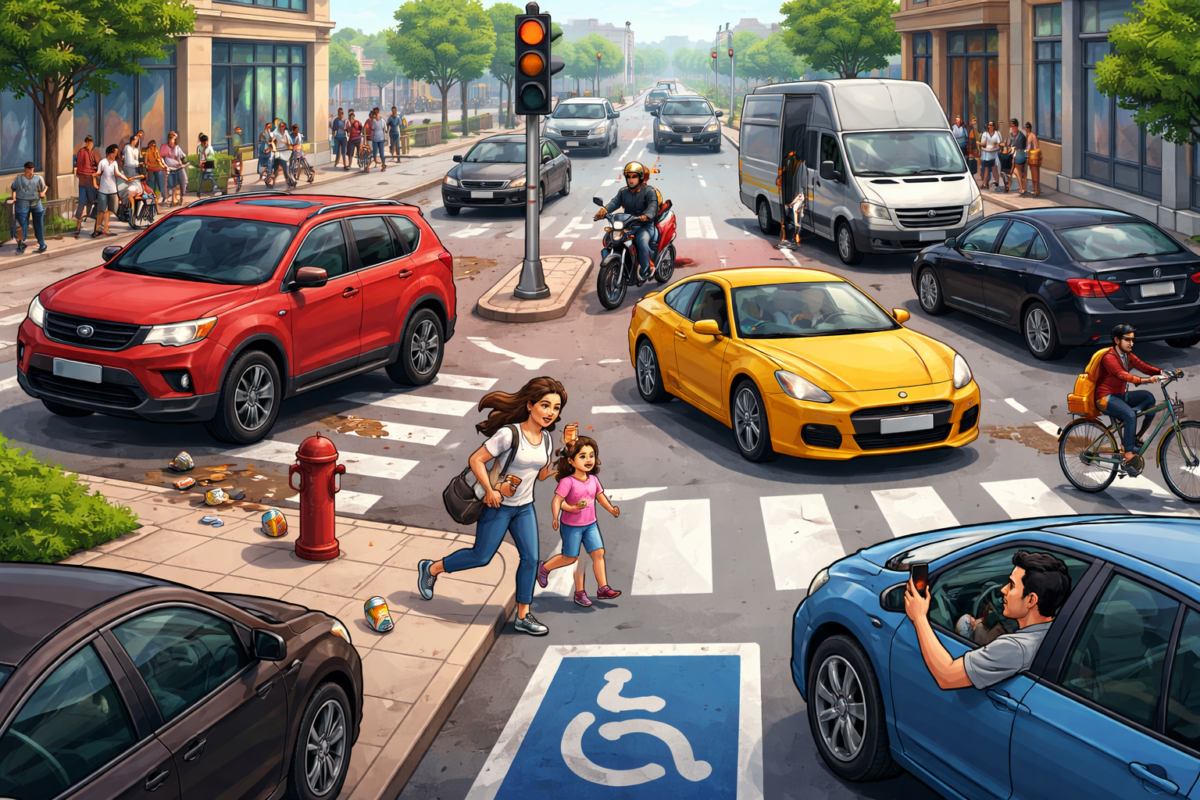
For months now, there has been ongoing discussion about traffic (in)culture—the one we so devotedly and almost affectionately nurture—and whether it will improve with the introduction of “Safe City.” It is obvious that we need a “whip” to understand that traffic is not a game, and that we, as participants in it, are not “pawns” who can simply return “into the game” if we step out of it today. We have behaved long enough like cats with nine lives, failing to grasp the seriousness of this big “game,” where constant punishment seems to be the only way for us to understand how serious it truly is.
I wouldn’t like to philosophize too much at the outset; instead, I’ll ask you this: how do you behave in this “game,” and how much do you respect the rules?
How often do you cross the street outside a pedestrian crossing? How often are you forced to walk on the road because sidewalks are filled with parked vehicles—and how many of you have parked as if the sidewalk were your own? How many of you cyclists ride on the street instead of the bike lane, riding side by side, wearing headphones, no hands on the handlebars, talking on the phone…? How many of you drivers respect speed limits, wear seat belts, allow children to sit between the seats just so they can see better and not cry—and how many of you didn’t wear a seat belt at all today? How many of you drove in a zigzag today just to catch the next traffic light on green? How many of you looked around to make sure there was no police officer and then, “at ease,” committed a violation? And we could go on like this until tomorrow… So isn’t it finally time to understand the rules of the game?
And every game is always played by two sides. In this case, the citizens and the state. Don’t think for a moment that I’ve forgotten that. The state absolutely must begin to enforce the rules more seriously and more consistently. Enough with campaign-style reminders after major accidents that rules exist and must be respected. Enough tolerance. Either for everyone, or for no one. Either once and for all, or never. Either “Safe City” will function the way it should, or it will remain just a good idea—one that has been working perfectly in other countries for decades.
To be continued…

Mladen Janevski
The reproduction, copying, or unauthorized use of copyrighted content (texts) from this page is not permitted. In the event of misuse, appropriate legal action will be initiated