


Every generation should move at least one step ahead of their parents — in education, material success, personal growth, and similar aspects. Of course, every generation also has its own challenges.
According to the theory of evolution by Charles Darwin, humans evolved from apes — but is the greatest challenge of today artificial intelligence? I would say that the use of artificial intelligence opens up new business opportunities.
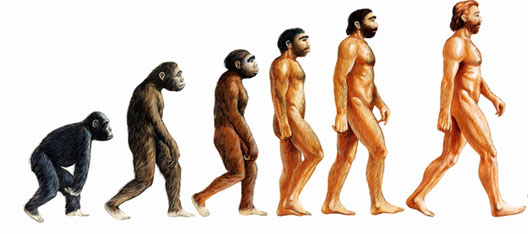
Our distant ancestors, driven by the instinct to survive and to have more — in other words, in search of food — came down from the trees and began to hunt. They stood upright on two legs, learned how to cultivate the land, and domesticated animals from which they obtained milk, meat, wool, leather, and other resources. Some chose to remain in the trees, eating leaves and insects and lounging on the branches — and thus remained apes.
But in reality, the true development of humanity began with the emergence of writing — when knowledge started to be recorded and passed down from generation to generation. In the beginning, power belonged to those who possessed knowledge, and there were even periods when that knowledge was jealously guarded and shared only with a limited group of people.
In the past, when people searched for new knowledge — exploring, traveling, and discovering new continents — they were seen as heroes, but also as devils, because change is difficult.
Today, in the era of modern technology and computers, everything is more accessible and easier, and at the same time knowledge can be obtained with just a few clicks on a computer or on your smartphone.
So today, life is easier from the perspective of survival — everything is more accessible, and all that remains is for us to take advantage of the benefits of modern times. That is true, but there is also a trap. Accessibility can dull us and make us lazy. And laziness is the greatest disease of modern society.
Namely, this availability of information, knowledge, and opportunities leads to the belief that everything can be achieved without much effort, that money and a better life can be attained easily.
Consumer society has distanced us from the spiritual, while various financial institutions offering quick money (loans) only reinforce this atmosphere of easy accessibility.
The essence of human existence remains the same: progress can only be achieved through effort, willpower, and learning—both materially and morally. However, this also means giving up many comforts and an easy life. There is, what I would call, a phenomenon here in Macedonia: during the workday, in working hours, cafés are full of people. This happens in every city across the country. The question is, why do people choose the easier path of not working instead of working and generating profit?
“Do you remember Sisyphus, the figure from Greek mythology who pushed the boulder up the hill, only for it to roll back down again?”
Laziness is the boulder that neither drags us downward nor allows us to climb the hill. Many of us choose not to push the stone. It is easier to remain at the foot of the mountain, blaming the heavens for the sun, the rain, and the wind. And you know what’s intriguing? Others at the foot of the mountain will agree with you that it is better and more comfortable there. So, is it really necessary to reach the summit? Just look at how many of us remain below.
As a side effect of this ailment come vanity and the tendency to blame others for our own failures. Surely you recognize it—the way everyone finds someone else at fault for what befalls them. Who, then, is anyone to tell me how or what I should do? We are all born for success, yet our parents did not support us; it is not laziness, nor the teacher or the principal to blame. We are innocent, yet our innocence goes unacknowledged.
The boulder is heavy, but there is another truth: success is the hardest thing for others to forgive. That is why many at the foot of the hill will pat you on the shoulder, glad that you remain with them rather than on the slope. In doing so, they justify their own existence in laziness and mediocrity.
The point of this text is that the transformation of a society must and begins with the individual. Each person must strive and push the boulder up the hill, regardless of its weight or the uneven terrain
Change is also an individual act. You will find many techniques for success, countless ways to motivate yourself, and endless recommendations—but without the will and desire to change, no transformation will occur. There is no guaranteed recipe for success
No matter how long it takes us to climb, as we ascend, the boulder will grow ever heavier—but the view from the summit is more beautiful and worth every hardship
Is it not so? Even the longest journey begins with the first step

M.Sc. Rade Cholovic