


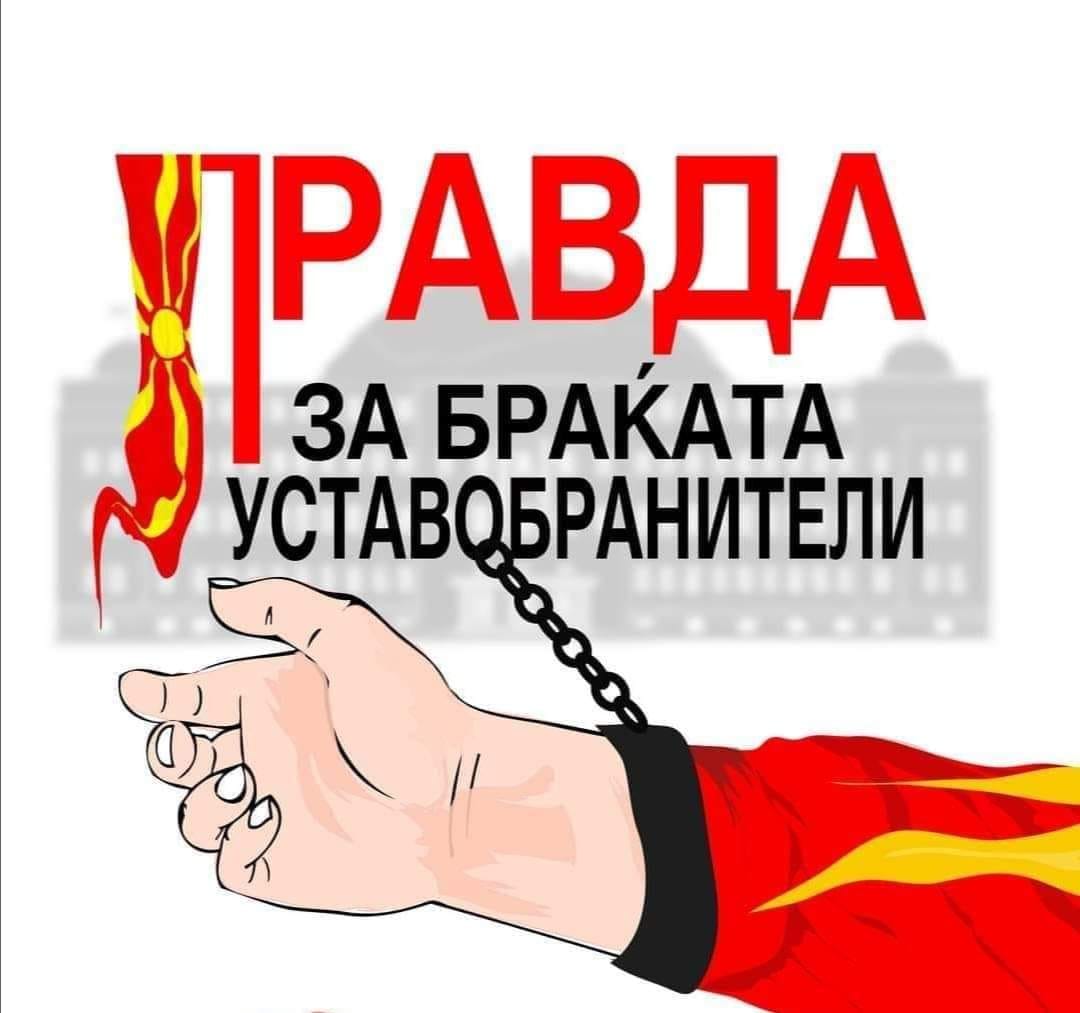
During an appearance on “Evening Show with Bogdan Ilievski”, Vlatko Trajkovski, who was wrongly convicted for the events of April 27, 2017, once again presented his personal and firm stance regarding the developments in Parliament, emphasizing that his presence that day was driven by conviction, not by any intent to commit violence.
Vlatko Trajkovski rejected the claim that he participated with malicious intent, stressing that his motives were, as he stated, “to defend Macedonia, the Constitution, and justice,” not to endanger the state. He reiterated that he has never accepted the label of “terrorist,” arguing that the events of April 27 cannot be reduced solely to a legal qualification, but must also be viewed within the broader political and social context in which they occurred.
In his conversation with Bogdan Ilievski, Trajkovski also spoke about his long-standing political and civic commitment, emphasizing that his stance remained unchanged even after the conclusion of the court proceedings. He stressed that he was neither an organizer of violence nor a decision-maker, but part of the crowd that, according to his words, reacted during a moment of deep political crisis.
In the public discourse, supporters of Vlatko Trajkovski and the others convicted for April 27 share the view that “the actions of these people will remain recorded as a source of pride for generations,” while, as they say, those who were behind the charges and convictions will bear the historical responsibility for the destruction of human lives.
In their rhetoric, it is emphasized that “hundreds of lives were destroyed for power, money, and positions,” and that the political processes have created divisions and hatred in society. Supporters believe that hatred can never overcome love for the homeland, and that time will deliver the final judgment.
For them, April 27 is not just a legal case, but a symbol of, as they say, the courage to stand by one’s convictions in defense of Macedonia and the Constitution. Part of the public continues to argue that these people are not terrorists, but citizens who believed they were protecting the state during a turbulent period.
The events of April 27 remain deeply etched in modern Macedonian history. While some view them as a serious attack on institutions, others perceive them as an act of resistance.
As Trajkovski conveyed on the show, history will reveal who was on the right side. And the support for those wrongly convicted does not fade; it continues to live among the people, in the belief that the truth always comes to light.
In the interview, Trajkovski stated that, as he claims, he was offered a so-called “illegal deal” during the court proceedings—an agreement he refused to accept. According to his words, accepting such a deal would have meant admitting guilt for an act that, he says, he did not commit in the manner attributed to him, as well as involving and “framing” other individuals connected to the events of April 27.
He emphasized that he chose to stand by his position despite the possible consequences, because, as he said, he did not want to accept a resolution that would go against his conscience.