

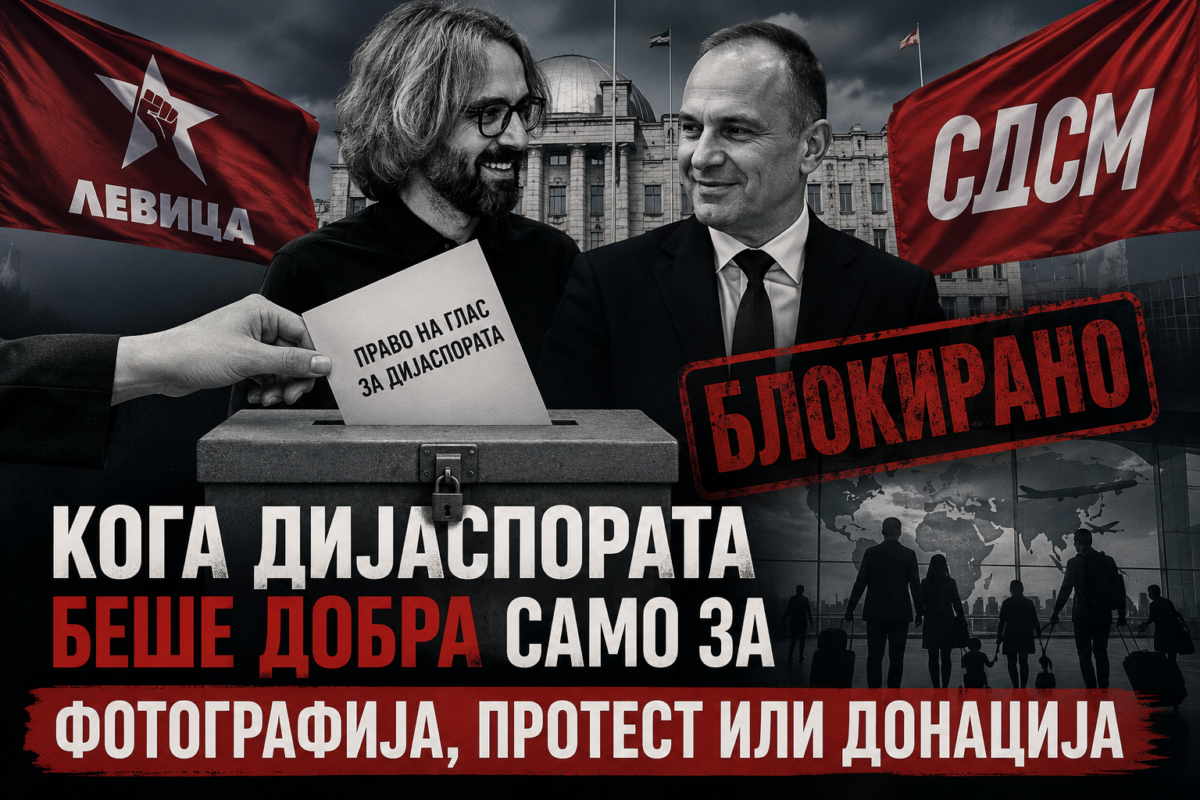
When the diaspora was good only for photos, protests, or donations.
In recent days, we have witnessed something that had long been anticipated. Today, Dimitar Apasiev and Venko Filipche are standing on the same side without hesitation when it comes to blocking amendments to the Electoral Code and reforms that also concern the Macedonian diaspora.
Someone will say: “Politics.”
I will say it like this: I have already seen this from the inside.
I was a coordinator for Levica Diaspora. I entered with ideas, a program, and a desire for someone to finally open the real issues of Macedonians living outside the country. I believed the diaspora would be a partner, not decoration.
But I quickly realized that interest in the diaspora lasted only when there was a need to fill protests, organize events, or secure financial support.
Back then, we were important.
When it came time to talk about real issues, such as the right to vote, organization, representation, and concrete policies, the conversations always ended with the same sentence:
“Yeah, yeah… we’ll see what we can do in Parliament. There are only two of us.”
I remember the so-called “Open Presidium.” I came prepared, with a plan, ideas, and questions from people in the diaspora. The response was that the day had been long and that it would be left for another time. But interestingly, there was time to discuss donations.
And that’s when I understood what the priority was.
During the protests against the French Proposal, the diaspora was elevated as a national force. The same happened around the Plenum, where the guests were Irish Members of the European Parliament Clare Daly and Mick Wallace. At that time, the diaspora was welcomed as support and a symbol.
But when it came time to systematically address the issue of its voice, the enthusiasm would disappear. I was even personally told: “I will take you to disciplinary proceedings because you didn’t organize me a tour around the diaspora.”
Then I realized that a representative of the diaspora was not what was being sought. What was being sought was an organizer.
Today, when Levica and SDSM find themselves on the same side regarding issues that directly affect the diaspora, this does not surprise me.
On the contrary, political differences magically disappear when party positions need to be preserved.
And once again, the interests of the citizens remain in second place.
The Macedonian diaspora must not be seasonal patriotism. It must not be important only when it is needed to protest, donate, or fill halls.
Ironically, isn’t it?
For years, Levica presented itself as the strongest alternative to SDSM. Today, when the issue of the Macedonian diaspora’s right to vote and reforms was raised, it is precisely there that they found common positions.
So much for the “difference.”
The truth is simple.
They are not afraid of a single law.
They are afraid of the voice of Macedonians they can no longer persuade with slogans.
That is why today Levica and SDSM are not on opposite sides.
They stand on the same side of the barricade.
And on the other side remains the Macedonian diaspora.

Zhivanka Morris is a social activist and publicist, recognized for her positions on strengthening the ties between Macedonia and the diaspora. As a former coordinator of Levica – Diaspora, she now critically analyzes political processes and advocates for policies that ensure greater representation, dignity, and voting rights for Macedonians living outside their homeland.